 Image via Wikipedia
CABLE TIE; also, CABLE CUFF, PLASTICUFF, ZIP TIE: A type of cuff consisting of a thin plastic strip with a row of teeth in its surface, and a small ratchet on one end. The end of the cable tie can be placed through the ratchet to form a loop which can be pulled tight but not loosened again. Sometimes used by police in favor of handcuffs.
CANE: A thin, flexible instrument used to strike a person. Canes are often made of rattan or a similar material, but may be made of other types of wood or even of flexible plastic such as polycarbonate. They are quite painful, often leaving marked welts. Also, verb to strike with a cane.
CAPTAIN'S DAUGHTER: Archaic, colloquial; see cat o' nine tails. Etymology:The cat o' nine tails was used as an implement of discipline aboard British Navy sailing ships beginning in the late 1600s. The term "captain's daughter" was a slang term for the cat o' nine tails popular among sailors, likely because it could not be used without the captain's express authorization.
CARABINER: Any device used to connect two chains or ropes together, often in the form of a D-shaped metal ring with a spring-loaded lever which can open the ring. See related panic snap. Commentary: Carabiners are not usually appropriate for suspension, as they cannot easily be removed if the suspended person's full weight is bearing down on them.
CAT: Colloquial; from cat o' nine tails: A generic term for any flogger whose lashes are braided or knotted, regardless of the number of lashes. Commentary:Knotting or braiding the lashes makes the flogger considerably more painful.
CAT O' NINE TAILS: A specific type of flogger consisting of a handle, often made of wood and wrapped with cloth, with nine lashes affixed to it. The lashes are usually made of rope or of leather cords, and are braided or knotted. Generally more painful than many other types of floggers. The cat o' nine tails was commonly used aboard British Navy sailing ships beginning in the 17th century. Commentary: The original cat o' nine tails was made by unbraiding a section of the rope used aboard British sailing ships. Each rope was made of three sections twisted together, each section of which consisted of three cords twisted together, so the rope when untwisted had nine tails.
CATHERINE'S WHEEL: A large, upright wheel, usually made of wood, to which a person may be bound and then rotated to any position.
CATHETERIZATION: The act or process of inserting a catheter, often as a part of a medical role play.
CBT: see cock and ball torture.
CHASTITY: The practice of disallowing any form of sexual release or sexual activity, sometimes imposed on a submissive by a dominant. Some forms of imposed chastity include the use of locking devices such as chastity belts to prevent direct sexual stimulation of the genitals. Also sometimes called chastity play, enforced chastity.
CHASTITY BELT: Any device intended to prohibit contact with or stimulation of the genitals. Female chastity belts often take the form of a lockable harness which passes between the legs and around the waist; male chastity belts may include a locking enclosure into which the penis is placed.
CHASTITY PIERCING: Any body piercing intended to prevent sexual intercourse; as, piercings along the labia which can be locked together to prevent penetration, or a piercing of the foreskin which can be used to pull the foreskin over the head of the penis and lock it in place.
CHEMICAL PLAY: Any form of sensation play involving the use of mild irritants such as wintergreen oil, menthol, Tabasco sauce, and the like to create sensation.
CHDW: (Acronym) Colloquial Clueless Horny Dom Wannabe. A derisive term for a person who proclaims himself or herself a dominant, but who has little or no real-world experience, and/or behaves with reckless disregard for the needs or safety of the submissive. Pronounced "chudwa." Usage: Invariably indicates disdain for the person so named. Etymology: Originated on the now-defunct Usenet newsgroup alt.sex.bondage.
CICATRIZATION: 1. Formally, medicine The process of wound closure by means of scar tissue formation. 2. See scarification.
CINCHER; also, RIBBON CORSET, WAIST CORSET: A specific type of corsetwhich is shorter than a full corset and wraps around the wearer's waist.
CINCH KNOT: A specific type of knot made by passing a rope or line through an opening, then around and around itself several times, and finally through a loop near the opening.
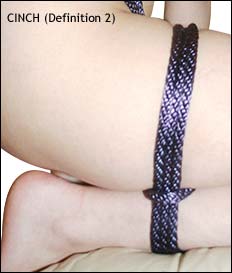
CINCH: 1. To wear a cincher, often very tightly and sometimes as a form of body modification. 2. To tie with rope by making several windings of rope around two limbs, or around a limb and a fixed object, then passing a loop of rope around the windings. The loop of rope is used to regulate the tightness of the binding. 3. To tie a cinch knot.
CLEAVE GAG: A type of gag, usually mode of cloth, that is pulled tightly between the wearer's teeth and tied behind the head. The cleave gag forces the mouth partway open and is quite effective in preventing speech.
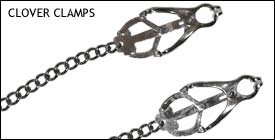
CLOVER CLAMP: A specific type of nipple clamp consisting of a clamp with a lever mechanism to which a chain or cord is affixed in such a way that pulling on the chain or cord increases pressure on the clamp.
COCK AND BALL TORTURE (CBT): Any of a number of different practices involving pain play of the penis and testicles, including such practices as binding, compressing, striking, or stretching the penis or testicles. See related parachute.
COCK RING: A ring (often made of metal or rubber) or strap designed to be affixed around the base of an erect penis. The ring allows blood to flow into the penis but constricts the penis sufficiently to prevent blood from flowing out, preventing the penis from becoming flaccid once it is erect.
CO-DOM: 1. A person who acts in conjunction with or as an assistant to a dominant during a specific scene. 2. A person who shares a submissive with another dominant, often in the context of a »polyamorous« relationship. Also, verb to act in concert with another dominant.
COFFIN: An item of furniture consisting of a long, narrow box, sometimes shaped like a conventional coffin, padded on the inside and usually featuring built-in restraints, a lockable lid, or both. The lid of a coffin typically features small openings or flaps at the level of the face, breasts, and genitals, allowing people outside the coffin to reach in and stimulate the person inside, or to allow the person inside to perform oral sex on those outside.
COLLAR: An item worn around the neck, sometimes equipped with a locking device to prevent its removal, and often worn as a symbol of submission. Also, verb To put a collar on, often as part of a ceremony indicating a committed relationship between a dominant and a submissive. See also corset collar, drop collar, posture collar, training collar; see related collaring ceremony.
Commentary: Some people outside the BDSM community associate collars with animals or pets, and erroneously believe that a collar is a sign of humiliation or is used to dehumanize a submissive; however, the symbolic value of a collar within the BDSM community is completely different.
Commentary: Some people outside the BDSM community associate collars with animals or pets, and erroneously believe that a collar is a sign of humiliation or is used to dehumanize a submissive; however, the symbolic value of a collar within the BDSM community is completely different.
COLLARED: The condition of having engaged in a committed, long-term relationship to a dominant, often by means of a collaring ceremony of some kind.
COLLARING CEREMONY: A formal ceremony celebrating or symbolizing a commitment between a dominant and a submissive, typically during which a collar is placed around the submissive's neck.
Commentary: There is no single type of collaring ceremony, and not all people in committed relationships in the BDSM community practice collaring ceremonies. A collaring ceremony in the BDSM community has many of the same kinds of social significance as something like a marriage or a wedding; often, the process of collaring is used to indicate a committed long-term relationship, particularly in TPE relationships. A submissive who has participated in such a ceremony is often said to be "collared to" his or her dominant. A collar in this context has symbolic value not unlike that of, say, a wedding ring. Collaring ceremonies may be public or private, and may include whatever elements the people involved find appropriate. Collaring ceremonies may or may not imply a monogamous relationship; one dominant may have more than one collared submissive, but it is extremely uncommon for one submissive to be collared to more than one dominant. A collaring ceremony is sometimes used to mark the formal beginning of a TPE relationship.
Commentary: There is no single type of collaring ceremony, and not all people in committed relationships in the BDSM community practice collaring ceremonies. A collaring ceremony in the BDSM community has many of the same kinds of social significance as something like a marriage or a wedding; often, the process of collaring is used to indicate a committed long-term relationship, particularly in TPE relationships. A submissive who has participated in such a ceremony is often said to be "collared to" his or her dominant. A collar in this context has symbolic value not unlike that of, say, a wedding ring. Collaring ceremonies may be public or private, and may include whatever elements the people involved find appropriate. Collaring ceremonies may or may not imply a monogamous relationship; one dominant may have more than one collared submissive, but it is extremely uncommon for one submissive to be collared to more than one dominant. A collaring ceremony is sometimes used to mark the formal beginning of a TPE relationship.
CONSENT: Affirmative permission, assent, or approval. In a BDSM context, "consent" is an affirmative assent to engage in a particular activity, freely given without coercion or distress. Informed consent: Consent freely given with full and prior knowledge of the conditions and potential consequences of the assent.Also, verb To give affirmative permission to engage in an activity.
Commentary:Consent is one of the hallmarks of BDSM, distinguishing it from abusive activities which may appear superficially similar. Consent is based on the active, willing participation of everyone involved in a particular activity; for example, if two people are engaged in something like pain play, a key defining characteristic which differentiates this play from physical abuse is that all the people involved know exactly what they're doing, want to be there, and give specific assent to the activities in question, whereas the victim of abuse does not specifically and affirmatively assent to the abuse. Consent is valid and meaningful only if it is informed, meaning that all the participants have full knowledge of the activities to which they are consenting (including but not limited to the circumstances under which the activity will take place and the possible risks, if any, inherent in the activity); if it is uncoerced, meaning that the participants give the consent freely without threat, force, or intimidation; and if the people involved give that consent from a condition of sound mind, meaning their judgement in not impaired by drugs, disease, or any other condition which might cloud or distort their ability to make reasonable, rational decisions.
Commentary:Consent is one of the hallmarks of BDSM, distinguishing it from abusive activities which may appear superficially similar. Consent is based on the active, willing participation of everyone involved in a particular activity; for example, if two people are engaged in something like pain play, a key defining characteristic which differentiates this play from physical abuse is that all the people involved know exactly what they're doing, want to be there, and give specific assent to the activities in question, whereas the victim of abuse does not specifically and affirmatively assent to the abuse. Consent is valid and meaningful only if it is informed, meaning that all the participants have full knowledge of the activities to which they are consenting (including but not limited to the circumstances under which the activity will take place and the possible risks, if any, inherent in the activity); if it is uncoerced, meaning that the participants give the consent freely without threat, force, or intimidation; and if the people involved give that consent from a condition of sound mind, meaning their judgement in not impaired by drugs, disease, or any other condition which might cloud or distort their ability to make reasonable, rational decisions.
CONSENSUAL NON-CONSENT: Any situation in which one person knowingly and voluntarily gives up the ability to prevent another person from doing whatever he or she wants; as, for example, deliberately engaging in activities which the submissive may be physically prevented from resisting and does not have a safe word. Some forms of rape play are consensual non-consent.
Commentary: Consensual non-consent is still consent. A person who gives consent in this way is giving affirmative assent to engage in an activity that he or she will not be able to stop in the middle; it can be thought of as consenting to an activity in such a way that the consent may not be revoked.
Commentary: Consensual non-consent is still consent. A person who gives consent in this way is giving affirmative assent to engage in an activity that he or she will not be able to stop in the middle; it can be thought of as consenting to an activity in such a way that the consent may not be revoked.
CONTRACT: A mutually negotiated, written agreement between a dominant and a submissive, outlining the submissive's limits, the activities the participants wish to explore, and the like. Commentary: BDSM contracts are not legally valid or enforceable, but are useful tools for defining what activities are and are not acceptable and in what contexts.
CONTRAPOLAR STIMULATION: Physiology Of or relating to any form of stimulation which produces both pleasure and pain sensations simultaneously.
CORPORAL PUNISHMENT: Any activity involving disciplining a person through physical means, as by spanking.
CORSET: An article of clothing, often made of leather, PVC, or vinyl and sometimes including strips of rigid "boning," which is tightly laced and designed to narrow the waist and lift the breasts, creating an "hourglass" figure. See related corsetry.
CORSET COLLAR: A specific type of posture collar, typically made of leather, vinyl, PVC, or similar material and sometimes containing rigid inserts or rigid metal sides, which is designed to lace up the front, back, or sides rather than buckling or locking closed.
CORSET PIERCING: A form of body modification in which multiple rows of rings are placed through a person's skin, then laced together with a silk cord or similar tie. Corset piercings can be done on the back, down the sides, or even on the labia, tying it closed. The piercings themselves may be temporary or permanent.
CORSETRY: The practice of wearing a corset, often laced extremely tightly, and sometimes constraining motion, as a form of body modification or for the purpose of control. See related lacing (def. 1).
CO-TOP: A person who acts together with or as an assistant to a top during a specific scene. Also, verb to act in concert with another top.
CRACKER: 1. A short piece of cord on the end of a whip, which makes a loud cracking sound as the whip is snapped. 2. Archaic, colloquial One who wields a whip. Commentary: The colloquial term "cracker" when used to describe a person from the rural southern United States originates with def. 2.
CRASH: Colloquial An abrupt feeling of depression or unhappiness immediately following the end of a BDSM activity. This feeling may be triggered by a number of different factors, including feelings of guilt (especially among people raised with traditional ideas about sex and relationships), confusion, unexpected psychological response to the activities, or even physiological processes such as a drop in the levels of endorphins. See related top drop, bottom drop.
CROP, also RIDING CROP: A thin, flexible instrument used for striking, consisting of a rigid but flexible shaft wrapped with leather or a similar material, with a handle at one end and often with a small leather loop at the other. Also, verb to strike with a crop.

CROSS-DRESSING: Sexual arousal or gratification from wearing clothing appropriate for the opposite sex.
CROSS-ORIENTATION PLAY: See orientation play.
CROTCH ROPE: See sukaranbo.
CUCKOLD: One whose partner practices cuckoldry.
CUCKOLDRY: The practice by which a dominant takes one or more sexual partners other than his or her submissive, for the purpose of humiliating the submissive. Commentary: Cuckoldry is distinct from the practice of»polyamory« in the sense that it is done in a context where the submissivehas no direct control over the dominant's other partners, and the primary purpose is to humiliate the submissive. Those who are aroused by cuckoldry are most often attracted to the humiliation and powerlessness aspects of it. The majority of the people who practice cuckoldry as a sexual fetish are women, who humiliate their male partners by having sex with other men.
CUFF: 1. Any restraint which has a band or band-like structure, which may be made of metal or of a flexible material such as canvas or leather, intended to be strapped or locked around an extremity such as a wrist or ankle for the purpose of securing or immobilizing it. 2. Archaic the fist. Also, verb 1. To restrain or immobilize by means of a cuff or cuffs. 2. To strike a rapid blow, as with the hand. 3. Archaic: Cuff with, to engage in a fistfight with.
CUPPING: A type of sensation play involving the use of small glass or plastic cups which are placed over the skin and then evacuated to create a vacuum, and hence suction. Some cups have an integrated valve to which a hand-operated vacuum pump can be attached; in other cases, the vacuum is created by dropping a flaming cotton ball, usually soaked in alcohol, into the cup and then placing the cup over the skin in such a way as to extinguish the flame. The vacuum is created by the contraction of the cooling air.


I love chastity belt too.
ReplyDelete